Hybrid vehicles are reaching new popularity levels in the U.S., with 2025 set to reveal new records. This is thanks to several reasons, the most prominent of which is the steadily increasing cost of gasoline in conjunction with the decrease in demand for fully electric vehicles . Modern hybrids are also relatively more affordable when compared to the pricing difference from their ICE counterparts just a decade ago. Most manufacturers have invested substantial capital in battery and electric drive unit innovations, which have filtered down into their HEV ranges. This results in improved efficiency ratings, more attractive economies of scale, and much more competitive pricing strategies.
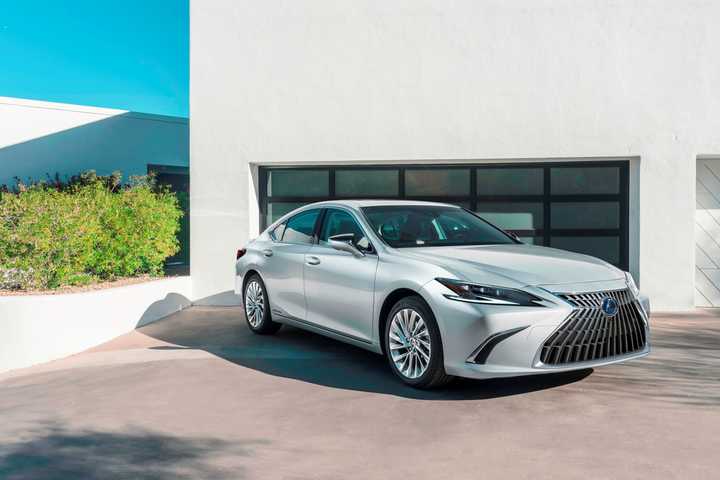

- Base Trim Engine
-
2.5L I4 Hybrid
- Base Trim Transmission
-
CVT
- Base Trim Drivetrain
-
Front-Wheel Drive
- Base Trim Horsepower
-
176 HP @5700 RPM
- Base Trim Torque
-
163 lb.-ft. @ 3600 RPM
- Base Trim Fuel Economy (city/highway/combined)
-
43/44/44 MPG
- Base Trim Battery Type
-
Lead acid battery
- Make
-
Lexus
- Model
-
ES Hybrid
As of Q2 2025, the Toyota Camry is the Japanese brand’s most popular HEV offering, and by a massive margin, eclipsing even the RAV4 Hybrid range. The biggest reason for its success is its highly competitive and accessible pricing strategy, but it also excels at delivering impressive fuel consumption figures and usable daily practicality. For those who want the Camry but with a much more luxurious finish, the Lexus ES comes as the perfect alternative, which we think is worth the noteworthy premium that you’d pay over the Camry.
To give you the most up-to-date and accurate information possible, the data used to compile this article was sourced from Lexus and other authoritative sources, including J.D. Power, iSeeCars, and the EPA.
Lexus ES Hybrid – Performance With The Benefit Of Reliability
Toyota’s Tried-And-Tested HEV Drivetrain

The Lexus ES 300h features an identical powertrain to the Toyota Camry, which consists of a naturally aspirated 2.5-liter four-cylinder Atkinson-cycle engine connected to a pair of permanent-magnet-synchronous motors. Unlike the Camry, you can only have the ES 300h with the front-wheel-drive system, producing a combined 215 horsepower. In true Toyota fashion, there’s no idea of how much torque the system produces.
2025 Lexus ES 300h Performance Specifications
Naturally, you shouldn’t be expecting the best performance from this model. Lexus claims that the ES 300h will sprint from 0-60 MPH in 8.1 seconds before hitting a 112 MPH limited top speed. As is the case with all naturally aspirated Toyota hybrids, the ES 300h features a direct-drive eCVT system as opposed to a conventional automatic transmission, making it the perfect fit if you find yourself traversing slow-moving urban and extra-urban environments. It is possible to use this model in full EV mode, but this is only under very strict conditions at slow-moving speeds, which is a common consideration for almost all hybrids in this segment.
Exceptional Fuel Savings And Consumption Returns

While you sacrifice power when driving a Lexus ES 300h, you do get to benefit from some of the most impressive fuel consumption returns that you can enjoy from the segment. According to the EPA’s estimates, you can expect this model to return a 43/44/44 MPG consumption on the city/highway/combined cycle and cover 581 miles on a single 13.2-gallon tank of gas, with some help from a 1.6-kWh lithium-ion battery pack.
2025 Lexus ES 300h EPA Estimates
|
Fuel Consumption (City) |
43 MPG |
|
Fuel Consumption (Highway) |
44 MPG |
|
Fuel Consumption (Combined) |
44 MPG |
|
Range |
581 Miles |
|
Five-Year Fuel Savings |
$3,250 |
|
Annual Fuel Cost |
$1,050 |
|
Cost To Drive 25 Miles |
$1.79 |
|
Cost To Fill The Tank |
$42 |
|
Tank Capacity |
13.2 Gallons |
|
Battery Capacity |
1.6 kWh |
Based on these same estimates, you can also expect to save $3,250 in fuel costs over the course of five years. A year’s worth of gas will cost you $1,050, while you’ll find yourself spending $1.79 to drive 25 miles. You’ll also be spending about $42 to fill up the tank.
Pricing Starts At $43,440 Before Destination
The Most Expensive Model Costs $52,330

The Lexus ES 300h is one of the best HEV cars you can buy for less than what you would spend on the average new car in 2025. The premium American-based Japanese brand kicks pricing off at $43,440 for the entry-level trim. Despite being a base model, it comes equipped with all the comfort and convenience features you’ll need, including dual-zone climate control, electrically adjustable front seats with heating, and perforated NuLuxe interior upholstery. You also get the eight-inch touchscreen infotainment system connected to the brand’s in-house-developed 10-speaker premium audio system. It also features wireless Android Auto and Apple CarPlay.
The $48,610 Luxury gets the added benefit of additional adjustments for the driver’s seat, quilted and perforated semi-aniline leather upholstery, front seat heating and ventilation, wood trimmings, ambient lighting, an electronically adjustable rear sunshade, a wireless smartphone charger, and a heated multifunction steering wheel with wood and leather trimmings.
Ultra Luxury And F Sport Appointments

The Ultra Luxury is the most expensive model in the range, with a $52,330 starting price, but this includes every available feature as standard, such as rear door sun shades, a 10.2-inch heads-up display, and the larger 12.3-inch touchscreen infotainment system.
The F-Sport Design costs $47,825 and mimics the Luxury trim, apart from a couple of bespoke visual exterior and interior cues. For $49,735, you can upgrade this to the F Sport Handling package, which adds performance dampers, adaptive variable suspension with bespoke F Sport tuning, and additional driving modes. Lexus’s $2,790 Premium package is available for the base and luxury trims, and adds the following options:
- Heated and ventilated front seats with Lexus Memory System
- Rain-sensing windshield wipers
- Heated leather-trimmed steering wheel
- Fast-response interior heater
- Power-folding outside mirrors
- Wood trim
There’s also the $1,630 technology package, which includes a larger infotainment system and head-up display.
A Niche, But Successful Premium HEV
Its Higher Price Hurts Sales Performance

Due to its higher price and position in an already niche premium midsize sedan segment, the Lexus ES 300h achieves some staggered sales figures, with Q2 2025 plus July reflecting 10,400 individual copies sold. This is admittedly a 9.8 percent increase over the same period last year, but nowhere near as high as the results that the Toyota Camry brings in. The Japanese brand’s midsize HEV sedan sits with a 181,337 individual unit sales figure during the same period, reflecting a 142.8-percent sales increase compared to the same period last year. The brand sold 26,048 copies in July alone.
Strong Customer Satisfaction And Reliability

In terms of market and reviewer reception, the Lexus ES is one of the brand’s most respected and highly rated models. J.D. Power awards it an 82/100 consumer-verified overall rating, which includes 88/100 for quality and reliability, 73/100 for the driving experience, and 74/100 for resale, alongside an 87/100 rating for the dealership experience.
iSeeCars backs this with an 8.7/10 overall score, which includes 8.6/10 for reliability, 7.6/10 for retained value, and 10/10 for safety. Its reliability assessment also indicates that it benefits from an average lifespan of 15.9 years and should cover 174,223 miles without any major mechanical faults. The probability of reaching 200,000 miles is 32.7 percent if you typically drive 10,362 miles every year.
You’re Covered By A Comprehensive Standard Warranty
Lexus issues all of its hybrid vehicles with a standardized warranty package as standard, which includes a 36-month or 36,000-mile basic warranty, a 60-month or 60,000-mile powertrain warranty, and 60-month coverage for corrosion with unlimited miles. The brand also covers all hybrid components for 96 months or 100,000 miles, while the battery features a class-leading coverage of 120 months or 150,000 miles. You have the option of extending the basic warranty package up to 10 years or 125,000 miles via Lexus.
Lexus’s Standard Warranty Offering
| Full Warranty | 36 Months/36,000 Miles |
| Powertrain Warranty | 60 Months/60,000 Miles |
| Maintenance Warranty | 24 Months/25,000 Miles |
| Roadside Warranty | 24 Months/25,000 Miles |
| Corrosion Warranty | 60 Months/Unlimited Miles |
| Federal Emissions Performance | 24 Months/24,000 Miles |
| Federal Emissions Defect | 36 Months/36,000 Miles |
| Seat Belt And Airbags | 60 Months/60,000 Miles |
Lexus implemented this warranty offering in 2020, extending from the previous eight-year or 100,000-mile coverage. Toyota covers the hybrid battery for defects and manufacturing issues, ensuring repair or replacement at no cost within the warranty period. Additionally, the hybrid component warranty covers the electric motor and power control unit. Routine maintenance and wear-and-tear items, such as the 12-volt battery, fall outside this coverage. As we’ve mentioned, Lexus’s hybrid systems are typically very reliable and trustworthy, but the brand has had its fair share of recalls in this department over the years.