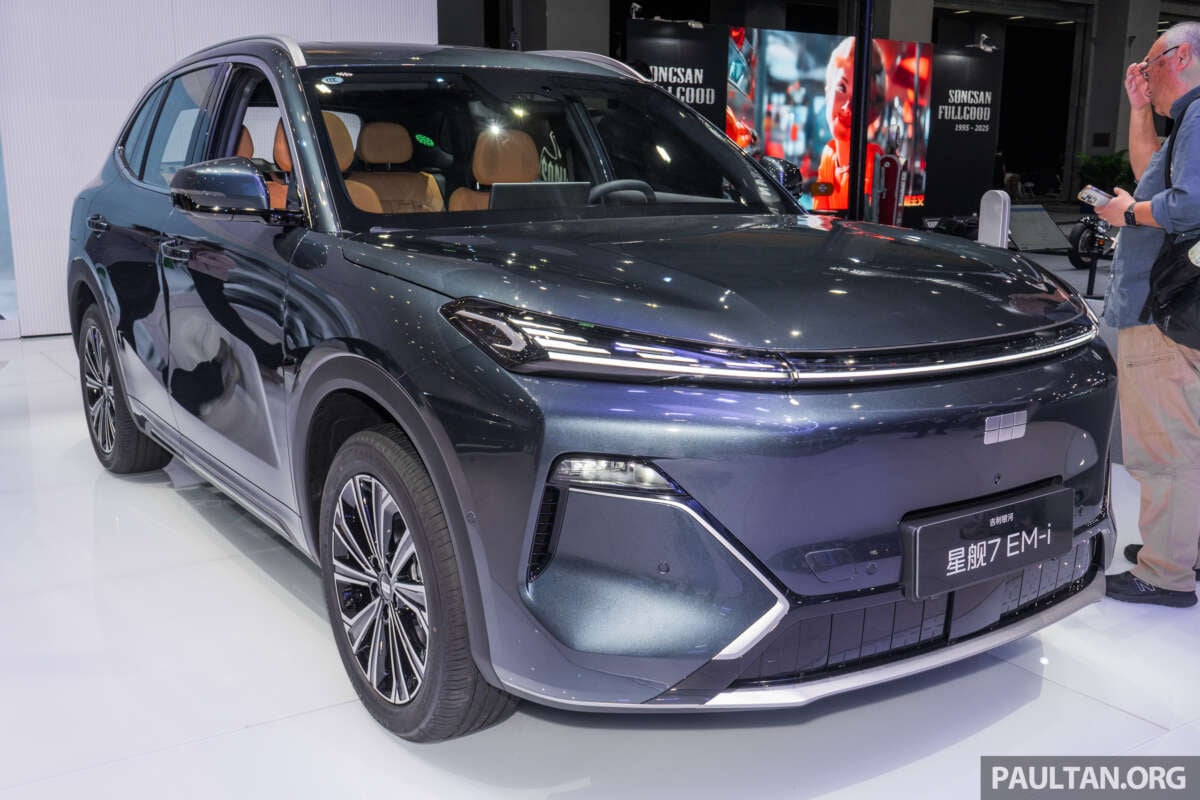

It’s been barely a year since the Geely Galaxy Starship 7 – sold globally as either the Starray EM-i or the EX5 EM-i – went on sale in China, but the plug-in hybrid SUV is already in for its first mid-cycle refresh, debuting at the ongoing Auto Guangzhou show. This update is significant because a larger battery is helping the car deliver an even more impressive range purely on electric power alone.
Geely’s efficiency-biased EM-i powertrain is largely the same, but the 1.5 litre BHE15PFI naturally-aspirated four-cylinder engine has been upgraded to the version found in the A7 and the Starshine 6, achieving the world’s highest thermal efficiency of 47.26%. Outputs are still identical at 111 PS and 136 Nm of torque, although the P3 electric motor integrated into the 11-in-1 single-speed dedicated hybrid transmission (DHT) now produces 238 PS and 262 Nm – 20 PS up on the previous model.
Presumably, this updated motor is also more efficient, because while the 19.09 kWh Aegis short blade lithium iron phosphate (LFP) battery remains the same, the car delivers slightly more electric range at 130 km on China’s more lenient CLTC cycle (135 km with aero wheels and an active grille shutter). This is now the standard version, so no more 55 km 8.5 kWh base battery for 2026.

Even bigger news is the optional 29.8 kWh Golden Brick pack that enables the Starship 7 to travel up to 200 km on a single charge, contributing to a total range of 1,575 km – an increase of 155 km from before. This battery also enables faster DC charging, taking five minutes less to charge from 30 to 80% (15 minutes).
Beyond that, the Starship 7 gains a new Starry Blue exterior paint option – which is darker than the previous Glacier Blue – and a Starship Grey interior; there’s also a larger 15.4-inch infotainment display (up from 14.6 inches), still running on the Flyme Auto infotainment system. Also new is the G-Pilot H3 suite of driver assists, enabling highly-automated highway and city driving and remote parking assist. A new blue light in the door mirrors indicates when the car is being driven autonomously.

Incidentally, the updates are coming to the Starship 7 immediately after spyshots of its Malaysian twin, the Proton eMas 7 PHEV, began circulating on social media. This raises the question about whether our version will receive the same tweaks – after all, the eMas 5 got the minor design changes of the 2026 Xingyuan, just days after the latter was launched in China.
However, while Malaysia was the first country outside China to receive the eMas 5/Xingyuan/EX5, things will be different this time around, as Proton is late to the party. The Starray EM-i has already been launched in Indonesia and Australia – with the smaller battery and a detuned version of the old engine, no less – so it’s likely we’ll receive the international spec instead. But hey, we can but dream, right?
Looking to sell your car? Sell it with Carro.