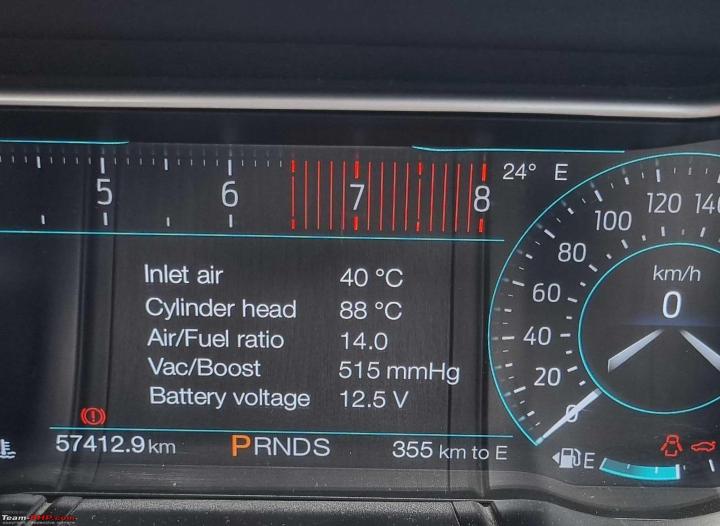
BHPian KomS_CarLog recently shared this with other enthusiasts: Hellooo Folks! It has been a very long time since I posted. A couple of months back, I got myself a second hand Mustang 2020 2.3L High performance 10 speed automatic transmission (thanks to my daughters and wife – otherwise would have gone for a manual). This b e a uty has 448Nm torque and 236kW power, more than enough for driving on the beautiful New Zealand roads. Man o man! This has been a looooonnnng time dream coming true…. This beauty comes with quite a few digital gauges for the pros I presume. Me not being one of them, I decided to at-least make an attempt to understand and enlighten myself. Searched team-bhp forum but could not find a lot of information. You guessed it, this post is about the various digital gauges available in the Mustang. Now now, should you spot some in-accuracies in this post, do forgive me. I am a novice just trying to put down my thoughts and understanding. More than happy to learn from the experts here. Healthy criticism/discussion is a good thing…so we all are told, and I guess it is right. With that little context and forgive-me note out of the way, now the real stuff. Let us dive in….. Here is a pic of my gauge cluster Air Fuel ratio gauge: This gauge displays the air to fuel ratio (AFR), within a range of 10 to 20. There is Chemistry wizardry at work here! And I shall not take the chemistry dive Reading a bit about air and fuel mixtures and combustion, I found that a ratio of 14.7:1 is considered the perfect ratio where all the air burns up all the fuel in the combustion chamber. This magic ratio is known is the “stoichiometric” for gasoline – the perfect chemical ratio! AFR = parts of air / part of fuel e.g. air mass / fuel mass Under heavy load/boost, the AFR becomes richer i.e. more fuel less air e.g. 11-12:1. This helps -keep exhaust temperatures safe. The combustion is cooler since there is more fuel which evaporates and hence cools the combustion – bringing it to acceptable levels. Note that under boost, the compression runs hotter than normal – as compressed and heated air is entering the combustion chamber, thanks to the turbocharger – increasing cylinder pressure tooPrevents knocking which is good for engine & turbo protectionDuring light cruise or deceleration, the AFR becomes leaner i.e. more air less fuel e.g. a ratio of >14.7. This helps -Increase fuel efficiency and reduce emissions too. When cruising, the engine needs little torque, meaning less fuel. So leaner AFR helps save fuel – smart!The combustion runs at low pressure and relatively lower temperatures (compared to under heavy load / boost conditions), despite the fact that leaner mixture burns hotter (lots of oxygen burns the little fuel entirely -> hotter exhaust gases). Engine parts (combustion chamber, turbo, etc.) love this leaner mixture as they do not have to deal with dangerous temperatures.ECU (Engine Control Unit) controls the AFR strategy:Rich ratio (more fuel) -> protection under high loadLean ratio (more air) -> safe under low loadVacuum Boost gauge: This reflects the pressure in the intake manifold – component that distributes air to the cylinders. This gauge essentially displays two phases Vacuum – You are not pressing the gas pedal i.e. no acceleration. The throttle is pretty much closed or partially closed. Car is cruising/chugging along the highway. The turbocharger is not in play. The piston movements are sucking air, to the best of their ability – and they just can’t get enough. This is called “engine vacuum” as the engine is sucking air. The intake manifold is below atmospheric pressure (~760mmHg) due to the engine sucking air with a partially closed throttle. The gauge Vacuum is measured in mmHg (millimeters of Mercury), from 750mmHg to 0mmHg. This is mmHg of vacuum i.e. how much below atmospheric pressure, the intake manifold pressure is. So:750 mmHg vacuum near true vacuum, meaning the real/absolute pressure inside the manifold is about760 750 = 10 mmHg0 mmHg vacuum = no vacuum, i.e. intake manifold has atmospheric pressure insideBoost – This is when you “gas it” for acceleration! The throttle opens up and more air is fed into the combustion chamber. The turbocharger comes into play – exhaust fumes spin the turbocharger fast, which makes the turbo compressor work hard too – compressing air and feeding it into the combustion chamber. Voila! You have more hotter denser air now, when compared to the vacuum scenario explained above. The b e a uty is literally on “turbo” steroids and gives you the acceleration you seek. The gauge Boost is measured in bar with ~1 bar nearly equal to the atmospheric pressure (~1.013 bar) – just another unit really. So you ask, why 0 bar on the gauge? The boost reading shows how much higher the intake manifold pressure is compared to atmospheric pressure. gauge Boost reading = absolute manifold pressure atmospheric pressure (~1 bar) Or absolute manifold pressure = gauge Boost reading + atmospheric pressure (~1 bar) So…0 bar on the digital gauge means intake manifold is at atmospheric pressure (~1 bar)0.5 bar boost on the gauge means intake manifold is at ~1.5 bar (1 + 0.5)1.0 bar boost on the gauge means intake manifold is at ~2.0 bar (1 + 1)In simple words, using the atmospheric pressure as the baseline, we haveBoost indicating the intake manifold pressure above the atmospheric pressureVacuum indicating the intake manifold pressure below the atmospheric pressureCylinder head temperature gauge: This indicates the metal temperature of the cylinder head (C or F) – which is important as it holds the combustion chamber and is the first to feel the heat! This gauge tends to be more accurate than the coolant temp gauge and gives you a more direct understanding of the engine condition (temperature wise). The ECU uses this data to make informed decisions (increase/decrease) on boost (discussed above), air/fuel supply (discussed above), fan speed, coolant flow, etc. In my b e a uty, I have noticed this hovering between 80 and 100 centigrade while driving on highway or in a traffic jam Inlet Air Temperature (IAT): Refer to the second image from the top. This measures the air temperature (IAT) in C/F, as it enters the engine. Following my research, IAT in the b e auty measures the temperature of air after it is cooled by the intercooler, and just before entering the cylinder. Makes sense as this gives the ECU pretty accurate data to make adjustments, where needed. IAT is used by ECU to adjust air fuel ratio (AFR above), ignition timing (this led me to reading about reducing timing by 1-2 degrees) for optimal engine operation and efficiency. It is a good indicator giving a holistic view of the turbocharger heat, engine bay heat and the intercooler efficiency. The cooler IAT is, the better as we get cool and dense air/oxygen -> more power I will be honest here. My initial hunch for IAT was -“Ah! that is simply a temperature reading. Shouldn’t be anything important I guess.”. Well, it may be just another tiny temperature reading but I now have a humble respect for what it can lead too G-Force Meter: This cool gauge displays the G-forces in action during acceleration (Forward), braking (Backward)and cornering (Left/Right). The b e a uty reads these very frequently and updates the gauge. Now how would this help? Gives a hint of issues with tyre pressure, suspension or alignment. While going through a roundabout, I actually saw the centre white dot (in the circle…more like a radar graph) moving! Very cool! Don’t ask how I managed to do that though. Apparently, the high braking G in the picture above is most likely due to the ABS braking. The brakes on my b e a uty are very very sharp and strong. I have changed my driving habit as I now need less distance to come to a standstill, however that is not the case for other cars behind me. Other observations: 1. After a cold start, I wait for the idling engine to hit ~800-900 RPM before I change gears. The idling engine hums at a little higher than 1000 RPM and take about 45 to 60 seconds to lower to ~900. When the gear is changed now, the b e a uty handles this without any jerk. Apparently, in the first 45 to 60 seconds, the higher idling helps warm up the transmission oil and build pressure too. Read BHPian comments for more insights and information.
Source link
Understanding the digital cluster guages on my 2020 Ford Mustang