Proper tire maintenance is important for the long-term health of your vehicle.
While it’s more fun to focus on the nuts and bolts of your car, making sure that your tires are properly cared for is an essential step in keeping your vehicle running for years to come. You can’t just set-and-forget tires, either — they need to be swapped between seasons, often inflated in the winter months, and have their pressure checked diligently to ensure one is getting the best performance out of them possible.
Speaking of tire pressure, which tire pressure is best for your car? And why do tire manufacturers make that answer so difficult to find? One internet user is asking — and the answer may surprise you.
Where Can You Find The Max Tire Pressure On Michelin Tires?
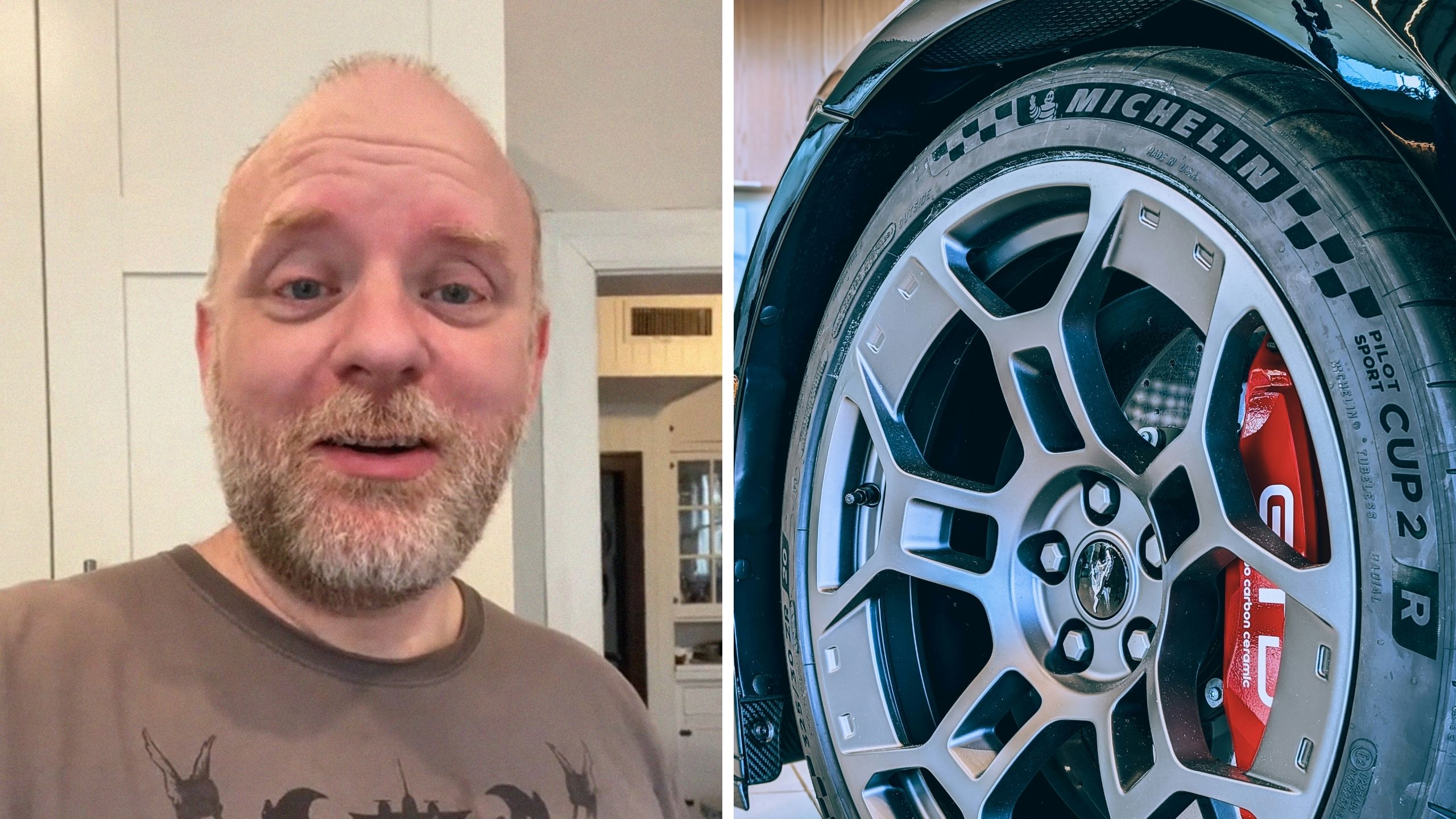
In a video with over 29,000 views, TikTok user Richard Tallent (@richardtallent2) shows a single Michelin tire on a car.
“So why is it that every time I fill up a tire, I have to look for the max pressure, and it is always like the smallest possible unreadable text on the tire?” he asks.
He then shows the outline of the tire. After a few seconds, he’s able to find the max pressure toward the rim.
“Why do they do that?” he asks.
What You Should Know About Tire Pressure Markings
As shown in the video, a tire’s maximum pressure is listed in small print on the sidewall. This is typically near the bead of the tire.
However, most drivers should not be following this advice. The marking on the tire simply shows the maximum pressure to which a tire can safely be inflated while cold. This does not mean that such pressure is ideal for your vehicle.
Instead of looking at the tire itself, one should look to the sticker inside their driver door. This sticker will list the PSI that one’s tires should be at when cold, before driving. For most car owners, this is between 30-35 PSI, but SUVs, trucks, and performance cars vary.
This isn’t the case for all car owners, of course. If one is running drastically different tires than stock — for example, if they’re using mud-terrain or ultra-low-profile tires — there are different recommendations for air pressure. Otherwise, the pressure recommended inside the driver door is what’s ideal for one’s vehicle.
What Happens If You Don’t Follow Tire Pressure Recommendations?
To summarize, the pressure listed on a tire is a maximum. This is the highest pressure the tire can safely hold to carry its maximum load capacity.
Still, some may wonder what happens if they inflate their tires up to this level — or deflate them below the recommended range.
Overinflated tires tend to wear prematurely, beginning at the center of the tread and eventually affecting the entire tire. This can cause safety concerns, as excessive inflation can reduce road contact and compromise traction. Consequently, braking distances increase, acceleration becomes less effective, and handling can become unstable.
Underinflating brings its own set of issues. If one underinflates their tires, they can see uneven tread wear, excessive heat buildup, and increased stress on the tire’s sidewalls. Prolonged driving under these conditions can ultimately result in a tire blowout.
The Car Owner Responds
In an email, Tallent shared why he filmed the video and made the comments in the first place.
“I had just finished airing up the tires on my camper which *should* generally be filled to the cold psi rating. I was musing to myself about why that number was so small and hard to find. On every tire, including others that should generally be filled to the rated cold psi, like bicycle tires,” he said. “So by the time I decided to *record* the video, I was checking the pressure on my truck’s tires. While these shouldn’t be filled to the max pressure, the font is just as small, so I figured it would be good enough for the B-roll of a quick Tiktok rant.”
“And that’s where I went wrong,” he continued. “The keyboard warriors started showing up and piling on.”
He said he proceeded to receive rude comments about his video — so much so that he ended up setting it to private.
Still, he says that proper tire pressure is important — he just had a specific case in which looking at the door sticker wasn’t appropriate.
“In reality, I’m using larger tires than came with the truck, *and* I was preparing to tow my camper (and using a weight distribution hitch), so all of the ‘just use the door sticker’ comments weren’t entirely accurate anyway,” he said. “I do my own calculations for the truck tires and use 39 in the back and 38 in the front when towing, not the 33/30 recommended by Toyota. But that sort of nuance is lost on social media.”
In the comments section, multiple users reiterated that, for most situations, the best place to look for ideal tire pressure was not the tire itself.
“You shouldn’t be setting your pressure based off the tire. ALL vehicles have a door sticker with the proper tire pressure for that vehicle,” wrote a user.
Some speculated that this was the reason that the “max pressure” was difficult to find on the tire.
“Because there is really no reason to look for that number. You never use that number,” stated a commenter.
For those who aren’t certain of their ideal pressure, or cannot find information from the manufacturer about it, a few commenters suggested other methods for figuring out the correct pressure.
“Chalk method is the only real way to find correct pressure if anything other than stock tire,” declared a user.
We’ve reached out to Michelin via email.