
Audio By Carbonatix
If you’re just joining the chat, there’s an interstellar object hurtling through our solar system right now. 3I/Atlas is moving about 210,000 km/h (roughly 130,000 mph). Astronomers predict it will pass relatively close to four planets (but not Earth) and the Sun, then continue its cosmic journey. A Harvard professor made headlines theorizing our visitor is a nuclear‑powered alien spacecraft.
Professor Avi Loeb makes some intriguing points. Most deep‑space travelers we’ve encountered are comets in long orbits around our Sun. They are made of mostly ice, so as they pass through the inner solar system they leave long tails of melting vapor. 3I/Atlas has a tail (coma) and is active like a comet. It’s not unprecedented for something this big to contain ice. What is unusual is its speed, trajectory, and brightness. Some say its flight path is perfect for observing much of our solar system while staying relatively hidden from Earthlings. But others argue those coincidences are far from conclusive evidence.
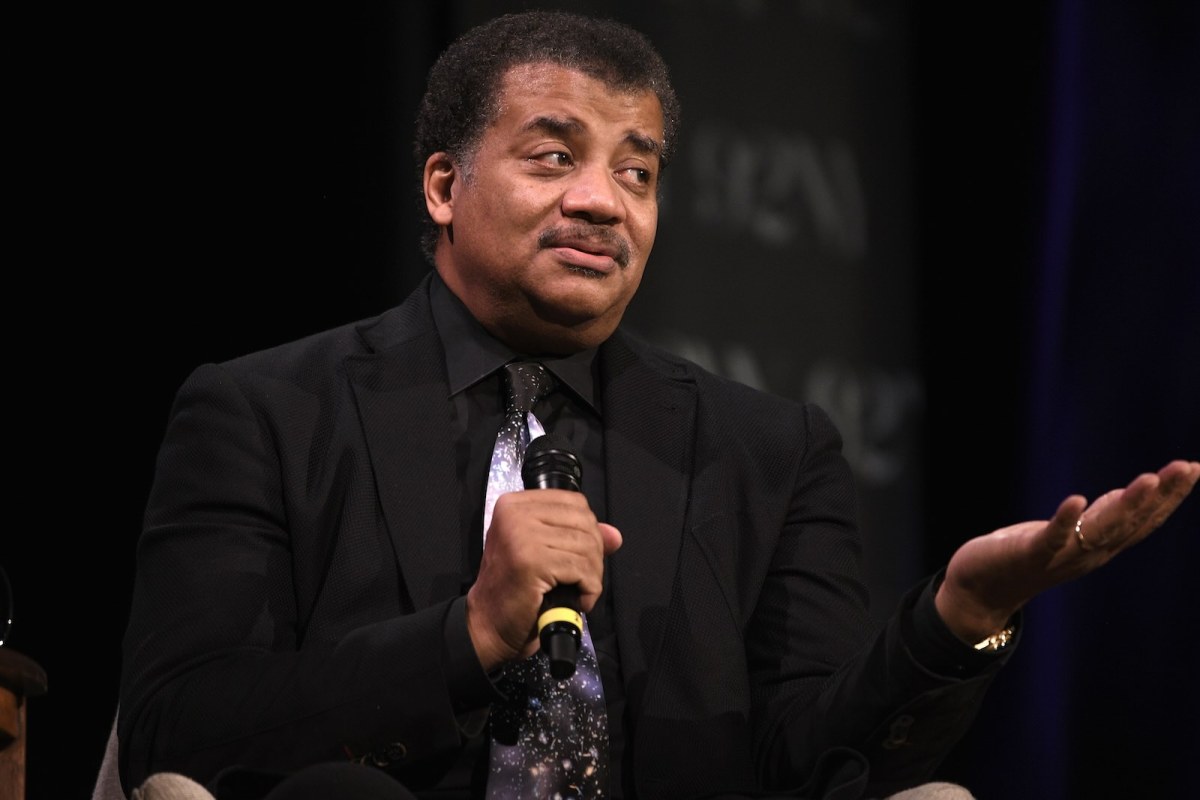
Tyson joins the 3I/Atlas chat
Neil deGrasse Tyson is a Harvard‑trained astrophysicist. His résumé includes lecturer and author, and he is one of the world’s most famous science communicators. His “StarTalk” show is one of the top 10 most popular science podcasts in the U.S. He recently weighed in on 3I/Atlas. But instead of looking to the skies for speculation, he looks back in history.
Tyson points out that we’ve only recently developed the technology to spot fast‑moving interstellar objects. In fact, we’ve only cataloged two before 3I/Atlas. And there’s still much to learn about them. “They have some weird properties. The brightness, the rotation rate, and so they don’t match some of our models for what comets and asteroids should do.” He is thrilled we’re stretching the bounds of what we know, but admits it may take years to fully understand these visitors. “Whatever anomalous behavior these objects exhibit, I’m delighted that they’re finally in the catalog.”
He warns against using the all‑powerful hand of alien civilizations “as a substitute for the simple statement, ‘I don’t know what it is.’” Tyson points out that all science is based on that statement as it inspires further investigation.
The God of the gaps
Before the modern scientific method, thinkers such as Newton explained what they could (such as the laws of physics or the way the planets orbit the Sun). “Every time they got to a point that they didn’t understand, in came ‘the power of a God.’” What causes the weather? The ancient Greeks said it was the rage of Poseidon. Why do orbits deviate over time? Newton said it was the power of God.
Historians call this pattern “The God of the gaps.” Tyson theorizes that today, “‘God of the gaps’ has been supplanted by ‘alien of the gaps.’”
Here’s an example: When our understanding of history says the ancient Egyptians would have been hard‑pressed to build the pyramids, some conclude, “They must have gotten help from aliens.” But the truth is a bit messier: There’s a lot we still don’t know about the ancient Egyptians and archaeologists should continue to study them.
Tyson warns, “The moment you say, ‘I don’t know what I’m looking at, therefore I know what I’m looking at. I’m looking at aliens.’ That is a leap.” He says a cosmic mystery should be a call to arms to collect more data. And for his part, Professor Loeb agrees that 3I/Atlas at least warrants further study. As the massive object passes Mars in October, NASA hopes to photograph it with telescopes orbiting the Red Planet.