Thirty years can be a long time, or a blink of an eye. It all depends on perspective. That time period means nothing to a Greenland shark, but for us, our existence will be made or broken in that period of time. We’ve even managed to change the environment significantly in three decades. Technology moves in a much faster cycle, and thirty years is an absolute eternity. You will probably go through five or six generations of a product in thirty years.
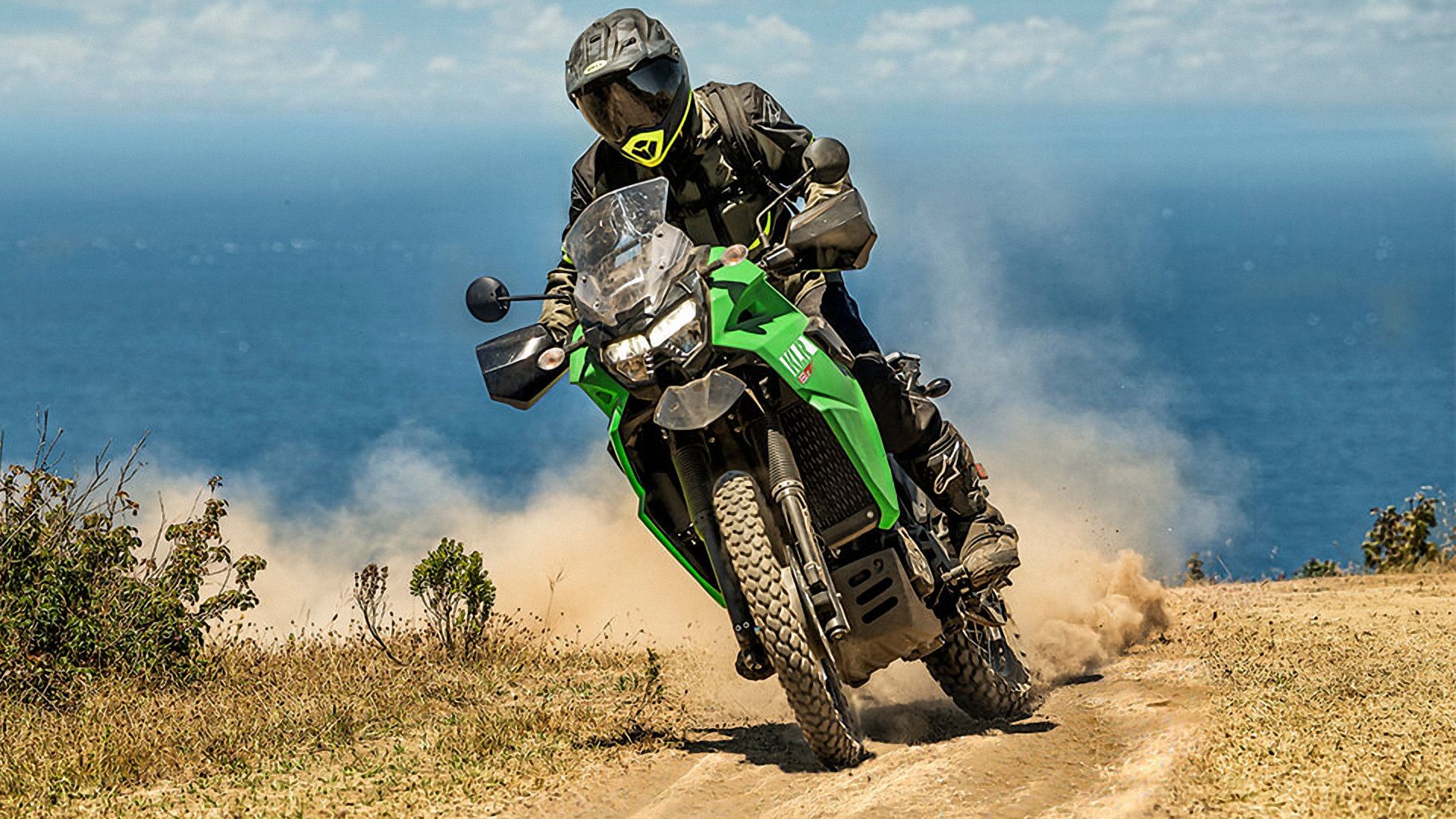
However, not all products are born equal. Some, like the crocodile, seem to have been engineered to perfection right from the start and see no need to evolve any further. These motorcycles keep going, while they keep putting smiles on owners’ and riders’ faces. Here is one such dual-sport product that hasn’t seen fit to bow down to the demands of time. This is the old-school Kawasaki that’s still in production after thirty years.
To give you the most up-to-date and accurate information possible, the data used to compile this article was sourced from authoritative sources such as Kawasaki Motorcycles.
The Kawasaki KLR650 Is The Old-School Kawasaki That’s Still In Production After 30 Years
Price: $6,899

The KLR650 debuted in 1987, nearly four decades ago, and was a replacement for the KLR600. It was a simple motorcycle back then, with an air-cooled, carbureted thumper to power it, a five-speed gearbox, chain drive, and long-travel suspension. It didn’t make headlining power, and it wasn’t the lightest bike that you could have to go off-road with. However, what it was, was reliable. As long as you weren’t in a tearing hurry, the KLR650 could get you there and back twice over without breaking into a sweat.

This reliability has been the calling card of the KLR since its inception – it is built for hard use, and even abuse, and it will simply refuse to give up. It is so reliable that even the US military decided to start using KLRs. When an organization that has Humvees and battle tanks at its disposal decides to use a product like this, there can be no higher certificate of validation!
The KLR650 doesn’t pretend to be something it isn’t (although it does a convincing impression of an adventure bike), and this feature is what makes it loved by its audience. The audience for it also knows what it is getting for the money, and is happy with the value delivered. That is why the KLR650 has survived with minimal changes for so long, and this is what has kept the KLR in production after thirty years.
What Makes The Kawasaki KLR650 Special
- Simple, reliable product.
- Seat height is reasonable for a full-size dual sport.
- Aftermarket support.
- Enough modernity to keep up with emissions and safety.
Kawasaki KLR650 Engine: Ol’ Reliable
FI Introduced In 2022

The KLR650’s initial debut had it running carburetion. It was always liquid-cooled, which helped the reliability. In 2008, the engine got dual counterbalancers to reduce vibration. The third and current generation got fuel injection in 2022, so as far as improvements go, it has caught up to the current levels required. There is nothing fancy here – a simple cable throttle, a five-speed gearbox, and a final chain drive complete the driveline. You will not find traction control, ride modes, or any other fancy electronics, which is why the KLR doesn’t break. And if it does, it is extremely easy to repair.
Truth be told, the gearbox could have used a sixth speed, both for better highway running as well as better performance. For all the torque it generates, this is a relatively heavy motorcycle for a thumper, so the power-to-weight ratio isn’t as good as one would like. Still, that isn’t its purpose, so owners are happy with it.
Kawasaki KLR650 Engine Specifications
|
Engine Configuration |
Single cylinder, liquid cooled, DOHC, 4 valves per cylinder |
|
Displacement |
652 cc |
|
Bore x Stroke |
100 x 83 mm |
|
Compression Ratio |
9.8:1 |
|
Power |
38.5 HP @ 6,000 RPM |
|
Torque |
39.1 LB-FT @ 4,500 RPM |
|
Fuel System |
Electronic fuel injection |
|
Transmission |
5-speed wide-ratio manual transmission |
|
Final Drive |
Chain drive |
Kawasaki KLR650 Chassis: Simple, Effective
Rear Shock Has Damping Adjustment

The KLR650 has a chassis that is rooted firmly in off-road intent. It is a steel semi-double cradle frame, which allows for engine protection while adding a little extra weight. The suspension couldn’t be simpler if it tried; regular telescopic forks with no adjustment at the front, and the rear monoshock has preload and rebound damping adjustment. The brakes consist of a disc at each end – a 300 mm disc with a two-piston floating caliper at the front, and a 240 mm disc with a single-piston caliper at the rear.
The 2022 update added ABS to the KLR, but oddly enough, Kawasaki hasn’t added a way to switch off the ABS, not even at the rear wheel, which seems like a pretty big oversight for a bike that is supposed to do a lot of riding off-road. The spoke wheels have a 21/17 inch diameter, and on/off-road tires fitted.
Kawasaki KLR650 Chassis Specs And Dimensions
|
Chassis |
Tubular steel semi-double cradle frame |
|
Front Suspension |
41 mm telescopic forks, 7.9 inches travel |
|
Rear Suspension |
Uni-Trak single shock, adjustable preload and rebound damping; 8.0 inches travel |
|
Front Tire And Wheel |
90/90 21 |
|
Rear Tire And Wheel |
130/80 17 |
|
Front Brakes |
300 mm disc, two-piston floating caliper |
|
Rear Brakes |
240 mm disc with single piston caliper |
|
Fuel Tank Capacity |
6.1 gallons |
|
Length/Width/Height |
89.8/38.2/57.3 inches |
|
Wheelbase |
60.6 inches |
|
Rake |
30 degrees |
|
Trail |
4.8 inches |
|
Seat Height |
34.3 inches |
|
Ground Clearance |
8.3 inches |
|
Curb Weight |
456 LBs |
Kawasaki KLR650 Features
Not A Lot In This Regard

The KLR650 is a rough-and-ready motorcycle that hangs its hat on reliability and the ability to be customized to whatever your needs may be. Ask the military, they got it to run on diesel fuel because that’s what military vehicles use. However, if you’re looking for features like a touchscreen TFT display, you’re in the wrong place.
The KLR still sports a simple LCD instrument cluster, and the 2022 update saw it switch to an LED headlamp. These, and the ABS, are the sum total of the KLR’s visual features. Oh, and you can have it in either black or white.
Kawasaki KLR650 Notable Features
- LCD display
- Non-switchable ABS
- Adjustable preload and compression damping for the rear shock
- LED headlamps
The KLR650 Faces Some Stiff Competition

You’ll be surprised to find out that the KLR isn’t the only one of its kind; both Honda and Suzuki have their equivalents as well. The DR650S is just like the KLR, but approaches the lower seat height differently. You get a factory conversion kit, whereas the KLR has a different variant (KLR650 S) that has a lower seat height.

Honda’s contribution is the XR650L, which is more of the same reliable retro goodness, but it has interesting features like the frame also being the engine oil cooler and tank. Neither the Suzuki nor the Honda offers ABS even as an option, while it is a $300 optional extra on the Kawasaki.
Kawasaki KLR650 vs. Rivals
|
Kawasaki KLR650 |
Suzuki DR650S |
Honda XR650L |
KTM 390 Enduro R |
Beta Alp 4.0 |
|
|
Price |
$6,899 |
$7,299 |
$6,999 |
$5,499 |
$6,490 |
|
Displacement |
652 cc |
644 cc |
644 cc |
399 cc |
348 cc |
|
Fuel Delivery |
Fuel injection |
CV carburetor |
CV carburetor |
Fuel injection |
Fuel injection |
|
Power |
38.5 HP @ 6,000 RPM |
43.5 HP @ 6,400 RPM |
43.6 HP @ 6,000 RPM |
44 HP @ 8,500 RPM |
35 HP @ 9,500 RPM |
|
Torque |
39.1 LB-FT @ 4,500 RPM |
39.8 LB-FT @ 4,600 RPM |
38.2 LB-FT @ 5,000 RPM |
28.7 LB-FT @ 7,000 RPM |
NA LB-FT @ NA RPM |
|
Chassis |
Semi-double cradle |
Twin spar |
Semi-double cradle |
Trellis |
Perimeter frame |
|
Gearbox |
5-speed |
5-speed |
5-speed |
6-speed, optional quickshifter |
5-speed |
|
Curb Weight |
456 LBs (wet) |
357 LBs (wet) |
346 LBs (wet) |
351 LBs (wet) |
308 LBs (wet) |

For more modern options, you’ll have to look to the KTM 390 Enduro R and the Beta Alp 4.0. Both of these sport-adjustable suspension and a far more modern chassis that behaves better everywhere. But neither has the reputation for reliability like the Japanese trio of unkillables does, because they’re simply too young.