The Subaru Forester is an interesting SUV these days. It’s been around, kicking ass on trails and snowy tracks since 1997. It’s not flashy, it’s not loud, and it’s definitely not trying to be the life of the party. But here’s the thing, the Forester is actually the super-capable, multitalented crossover that all the others want to be, but still doesn’t get its propers.
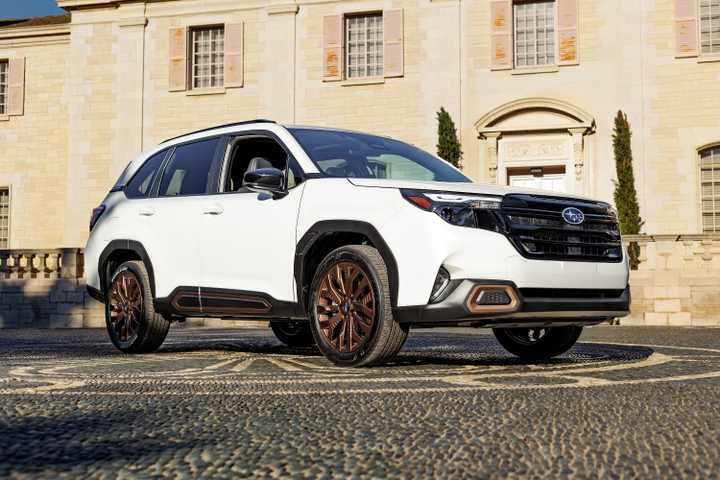

- Base Trim Engine
-
2.5L H4 ICE
- Base Trim Transmission
-
8-speed Lineartronic CVT
- Base Trim Drivetrain
-
All-Wheel Drive
- Base Trim Horsepower
-
180 HP @5800 RPM
- Base Trim Torque
-
178 lb.-ft. @ 3700 RPM
- Base Trim Fuel Economy (city/highway/combined)
-
26/33/29 MPG
- Make
-
Subaru
- Model
-
Forester
- Segment
-
Compact SUV
In a world obsessed with touchscreen sizes and “coupe-like rooflines,” the Forester is out here doing something increasingly rare in the SUV market: just everything right. It’s practical without being boring, capable without being clumsy, and affordable without cutting corners. Yet it still lives in the long shadows cast by the Honda CR-V, Toyota RAV4, and now, a flood of hybridized wannabes all vying for suburban dominance. Maybe that’s just how Subaru likes it. Or maybe we’re all sleeping on one of the best all-rounders you can buy today.
The Forgotten Member Of The Subaru Family

Subaru’s been on a quiet hot streak lately. The Outback continues to age like a fine whiskey barrel—rugged, dependable, and somehow cooler with every generation. The Crosstrek, meanwhile, is the darling of every young adventurer who’s ever said, “I could live in my car for a summer.” Even the Ascent, Subaru’s answer to the three-row family hauler, has carved out a respectable spot in the crowded midsize SUV market. And then there’s the Forester—sitting politely in the middle, waiting for someone to notice.
Despite being one of Subaru’s best-selling models globally, the Forester doesn’t get the kind of attention lavished on its competitors. The Honda CR-V and Toyota RAV4 dominate the conversation, bolstered by massive marketing budgets, flashy hybrid variants, and the sheer inertia of name recognition. The CR-V is the “sensible choice,” the RAV4 the “safe choice.” But if you look closely, the Forester might actually be the smartest choice.
Subaru’s Secret Sauce

Let’s start with the basics. Every Forester comes standard with Symmetrical All-Wheel Drive—not an optional extra, not something you tack on for a few grand more, but baked in. That alone sets it apart from most rivals, which are still selling front-wheel-drive crossovers to people who live in snowy climates. The Forester doesn’t care if it’s raining, snowing, or halfway up a gravel trail—it’s ready to go.
That AWD system pairs with 8.7 inches of ground clearance, the same as an Outback and more than most crossovers in its class. Add in Subaru’s X-Mode traction management and hill-descent control, and you’ve got a small SUV that’s more than just a grocery-getter—it’s a legitimate adventure buddy. But here’s the twist: the Forester doesn’t need to scream “outdoorsy” to prove it. It’s not pretending to be a Jeep. It doesn’t have fake skid plates or oversized decals shouting “Adventure Edition.” It just quietly gets the job done, in the way Subarus always have.
A Cabin That’s Built For Real Life

Step inside a Forester, and you’ll immediately sense a difference in priorities. While other automakers chase ever-larger screens and convoluted menus, Subaru focuses on the stuff that actually matters day to day. The visibility is phenomenal—thanks to the tall windows and upright seating position. The controls are physical, intuitive, and exactly where you expect them to be. It’s the anti-trend SUV, and it’s all the better for it.
The cabin is also massive for the size of the truck. The Forester’s boxy design pays dividends here, with a generous back seat and a massive cargo area—76.1 cubic feet of space with the seats folded, to be precise. That’s more than the CR-V and nearly identical to the RAV4, yet somehow the Forester still manages to feel easier to park and more maneuverable around town.

And because it’s a Subaru, you get the brand’s famously high safety ratings as part of the package. Subaru’s EyeSight driver-assist system—featuring adaptive cruise control, lane centering, and pre-collision braking—comes standard on every trim. The Forester routinely earns IIHS Top Safety Pick+ honors, and in real-world driving, it just feels unflappable. You won’t find neon ambient lighting or “massaging zero-gravity seats” here. What you will find is a car that nails the fundamentals—comfort, clarity, and confidence.
Reliability Without The Drama

One of the most quietly impressive things about Subaru as a brand is its consistency. The Forester doesn’t make headlines for recalls, transmission failures, or electrical gremlins. Its 2.5-liter naturally aspirated boxer-four may not sound thrilling on paper—182 horsepower and 176 pound-feet of torque—but it’s smooth, proven, and built to last.
Mated to a continuously variable transmission (CVT), it delivers solid efficiency for an AWD crossover, averaging around 29 mpg combined. And while some drivers gripe about CVTs in general, Subaru’s version is among the best, tuned to feel more natural with simulated gear steps and responsive throttle mapping.

Is it fast? Not particularly. But that’s not the point. The Forester isn’t trying to be a hot rod—it’s trying to be a companion. The kind of vehicle that starts every morning, gets you where you need to go, and never gives you a reason to curse at the dashboard.
The Price Advantage Nobody Talks About

Let’s talk money. The price starts around $29,995 for the 2026 Forester, and even a well-equipped Limited trim creeps up to just under $40,000. Compare that to the CR-V or RAV4, where higher trims can easily cross $40,000 before you’ve even added AWD or a moonroof.
Subaru’s pricing structure makes sense—every step up the trim ladder adds meaningful upgrades without feeling exploitative. You can choose how rugged, how tech-heavy, or how plush you want your Forester to be without paying for unnecessary fluff.
Why The Forrester Is Still Underrated
So, with all of that going for it, why isn’t the Forester at the top of the sales charts? Part of it is perception. Subaru doesn’t shout as loudly as Toyota or Honda. Its marketing is focused more on lifestyle—dogs, national parks, and community—than on horsepower or towing numbers. For some shoppers, that makes the Forester seem less exciting on paper.
Then there’s the design. Subaru’s aesthetic is… let’s call it “practical minimalism.” While the RAV4 gets aggressive angles and the CR-V leans toward modern sophistication, the Forester’s styling is quietly conservative. Some might call it bland; others would say timeless.

And finally, there’s the hybrid question. Both the CR-V and RAV4 now come with hybrid and plug-in options, giving them an edge with eco-conscious buyers. Subaru offers hybrid tech in the Crosstrek, but the Forester hasn’t made that leap—at least not yet. Still, for drivers who prioritize reliability, traction, and real-world usability over headline specs, the Forester is cheaper, safer, and just as reliable, not to mention, you can really adventure with it.
The Trustworthy Soul Of Subaru

There’s something refreshingly honest about the Forester. It doesn’t chase trends or rely on gimmicks. It doesn’t ask for validation from comparison tests or online hype. It’s a car built by people who know what matters on a wet morning commute, a dirt trail, or a family road trip.
The latest Forester Wilderness isn’t radically different. Nor does it need to be. It builds on an already exceptional off-road compact SUV with proven all-wheel drive, a bulletproof 2.5-liter engine, and all the tough add-ons families expect from a rugged adventure machine…going well over and above the competitors.
In an era when so many vehicles are designed to make you feel like you’re driving a smartphone, the Forester still feels like you’re driving a car. You sit up high, see everything around you, and feel a mechanical confidence that comes from decades of Subaru’s all-weather engineering DNA. If the RAV4 is the class president and the CR-V is the teacher’s pet, the Forester is the reliable friend who always shows up when things get tough—and never makes a big deal about it.
TopSpeed’s Take: An SUV You Can Depend On

The Subaru Forester might not dominate the sales charts or the headlines, but it dominates where it counts: safety, comfort, confidence, and value. It’s the SUV for people who measure quality by miles, not marketing.
Sure, it won’t turn heads in the Whole Foods parking lot or break drag strip records—but neither will any other crossovers, but it will get you home in a blizzard, up a mountain trail, or across the country without a single complaint. And maybe that’s the point. Because when the Instagram-ready crossovers are chasing the next big thing, the Forester is doing what it’s always done best—being the SUV you can trust, no matter what.
Sources: The EPA, NHTSA, J.D. Power